Re: SI BUANA... lo que usted diga.
Posted by Mr Mindundi on
URL: http://foro-crashoil.109.s1.nabble.com/SI-BUANA-lo-que-usted-diga-tp27204p27366.html
2.1.3 Heat-accumulatina solar cookers
Heat-accumulating solar cookers gather the heat of the sun all day long and store it for use sometime after sundown - or even the next morning. They eliminate one of the main drawbacks of all other solar cookers, which are only useful during sunshine hours. Heat storage, by contrast, extends the cooking option to the time of day when most cooking is done in Third World cultures: in the morning and in the evening.
The simplest type of heat-accumulating solar cooker is an ordinary box-type solar cooker containing a few bricks. That alone is enough to shift the cooking time from the late afternoon towards the early evening. However, the method is not very efficient and really only useful for keeping the food warm somewhat longer.
Strictly speaking, turning a solar cooker into a heat accumulator requires some very special design considerations. Such devices contain substantial amounts of heat-retaining material and are usually designed to withstand very high temperatures, since the mass required to store a certain amount of thermal energy is inversely proportional to the temperature. The weight of the heat store, the heat-transfer mechanism and the (highly efficient or concentrating-type) high-temperature collector make the cooker quite heavy and voluminous, complicated to build, and usually quite expensive.
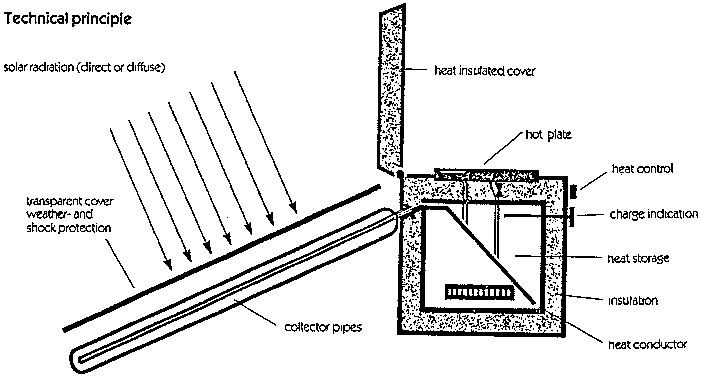
The more familiar designs use heat stores consisting of iron, magnesite, water or a high-boiling fluid (thermal oil). The Bomin Solar Hot Plate Cooker uses a funnel-shaped reflector to amplify the incident radiation by a factor of roughly 3 in order to heat a set of iron plates to very high temperatures in a sort of cooking box. The iron plates are then removed and transferred to a separate cooking area, where they impart their heat to cooking pots. The heat-accumulating solar cooker designed by Pohlmann/Stoy uses high-efficiency evacuated collector pipes to trap solar energy. The heat is transferred by heat pipe to the solid heat store, which then delivers controlled amounts of heat to a hot plate.
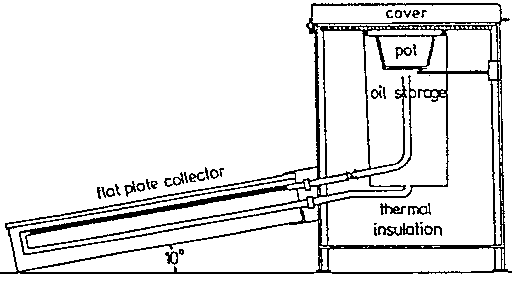
The ISE heat-accumulating solar cooker uses a highly efficient oil-filled flat plate collector that operates on the thermosiphon circulation principle to carry heat to an elevated hot-oil storage tank. Gravity circulation transfers the heat to the oil tank without need of a pump. The cooking pot stands in a matching depression in the top of the oil tank. The heataccumulating steam cooker devised by Mills and Qiu (solar cooking stove) stores heat in pressurized water at more than 100ºC. Heat extraction via the cooking pot lowers the system's internal pressure, thus causing the water to boil and carry more heat to the pot according to the heat-pipe principle.
The possibility of storing latent heat in solar cookers has been investigated in detail /99/. Latent-heat stores can collect heat without experiencing an increase in temperature. Instead, they undergo a physical change of state. In principle, this makes it possible to store more heat at a lower temperature and/or in less storage mass than in the case of normal (sensible) heat storage. The lower temperature reduces heat losses, a fact which is of advantage for collecting heat as well as for storing it.
A great number of latent-store substances and mixtures were investigated in /99/. The main preconditions were that the conversion (i.e. latent-storage) temperature had to be situated within a range regarded as acceptable for solar cooking (150...300ºC), and the material had to be relatively nontoxic, inexpensive, stable and available. Of all the tested metals, alloys, organic compounds and inorganic saline mixtures, the mixture NaNO2/NaNO3 emerged as the most favorable (in relation to the others), but there is still a long way to go before a really serviceable latent-heat-storage solar cooker can hit the market. Among the problems still to be remedied:
- corrosion due to the mixture's chemical aggressiveness
- the design of the heat box and the fit to a suitable type of focussing reflector
- the elimination of phase-separation problems in long-term operation - sundry technical problems and
- ascertainment of the system's acceptance potential.
To the knowledge of the authors, there is presently no work being done anywhere on a solar cooker featuring latent-heat storage.
All heat-accumulating types of solar cookers have one thing in common: they are so expensive as to be unaffordable for the average family in a developing country. Consequently, it is precisely the rural population that loses out. With that in mind, two cooker designers sized their units large enough to serve at the institutional level, i.e. in schools, hospitals, etc.
Some of the advantages of heat-accumulating solar cookers are:
- Cooking can also be done in the evening, i.e. after sunset
- The cook needn't stand out in the sun ,
- The food is easily accessible,
- Some units can be used for baking, too
- The achievable temperatures are higher than those produced by cooking boxes
- Some collectors require little or no solar tracking.
Their drawbacks:
- Their extremely high cost (up to US$ 2000 or more) could only be lowered by mass production
- Various "exotic" materials and components are used
- The storage units are heavy and immobile
- It is hard to get a good, uniform transfer of heat from the heat store to the cooking pot; one such cooker requires the use of pots with surface-ground bottoms (electric cooking pots).
2.1.4 Steam cookers
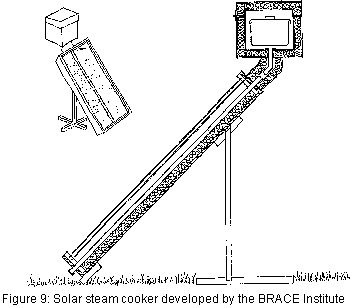
Solar steam cookers use an efficient (flat plate) collector to generate steam, which then rises to an elevated cooking box, where it heats the bottom and sides of the cooking pot and, hence, the food.
Fixed-focus concentrators, heat-accumulating solar cookers and other designs in which the collector is separate from the stove offer the potential advantage of being able to cook in the shade or even indoors. The cooking temperatures are moderate, and the efficiency is very low (about 15%), with accordingly long cooking times; such cookers are quite elaborate and expensive in relation to their performance.
In addition to the advantage of being able to cook in the shade or indoors (thanks to separation of the collector from the stove), steam cookers also afford easy access to the food, the flat plate collector makes use of diffuse radiation, and the unit rarely or never has to be aligned with the sun.
Despite their relatively elaborate design, solar steam cookers have relatively modest cooking capacities, since the transfer of heat from the steam to the cooking pot is rather inefficient, and the cooking temperature is almost always limited to about 100ºC.
URL: http://foro-crashoil.109.s1.nabble.com/SI-BUANA-lo-que-usted-diga-tp27204p27366.html
2.1.3 Heat-accumulatina solar cookers
Heat-accumulating solar cookers gather the heat of the sun all day long and store it for use sometime after sundown - or even the next morning. They eliminate one of the main drawbacks of all other solar cookers, which are only useful during sunshine hours. Heat storage, by contrast, extends the cooking option to the time of day when most cooking is done in Third World cultures: in the morning and in the evening.
The simplest type of heat-accumulating solar cooker is an ordinary box-type solar cooker containing a few bricks. That alone is enough to shift the cooking time from the late afternoon towards the early evening. However, the method is not very efficient and really only useful for keeping the food warm somewhat longer.
Strictly speaking, turning a solar cooker into a heat accumulator requires some very special design considerations. Such devices contain substantial amounts of heat-retaining material and are usually designed to withstand very high temperatures, since the mass required to store a certain amount of thermal energy is inversely proportional to the temperature. The weight of the heat store, the heat-transfer mechanism and the (highly efficient or concentrating-type) high-temperature collector make the cooker quite heavy and voluminous, complicated to build, and usually quite expensive.
The more familiar designs use heat stores consisting of iron, magnesite, water or a high-boiling fluid (thermal oil). The Bomin Solar Hot Plate Cooker uses a funnel-shaped reflector to amplify the incident radiation by a factor of roughly 3 in order to heat a set of iron plates to very high temperatures in a sort of cooking box. The iron plates are then removed and transferred to a separate cooking area, where they impart their heat to cooking pots. The heat-accumulating solar cooker designed by Pohlmann/Stoy uses high-efficiency evacuated collector pipes to trap solar energy. The heat is transferred by heat pipe to the solid heat store, which then delivers controlled amounts of heat to a hot plate.
The ISE heat-accumulating solar cooker uses a highly efficient oil-filled flat plate collector that operates on the thermosiphon circulation principle to carry heat to an elevated hot-oil storage tank. Gravity circulation transfers the heat to the oil tank without need of a pump. The cooking pot stands in a matching depression in the top of the oil tank. The heataccumulating steam cooker devised by Mills and Qiu (solar cooking stove) stores heat in pressurized water at more than 100ºC. Heat extraction via the cooking pot lowers the system's internal pressure, thus causing the water to boil and carry more heat to the pot according to the heat-pipe principle.
The possibility of storing latent heat in solar cookers has been investigated in detail /99/. Latent-heat stores can collect heat without experiencing an increase in temperature. Instead, they undergo a physical change of state. In principle, this makes it possible to store more heat at a lower temperature and/or in less storage mass than in the case of normal (sensible) heat storage. The lower temperature reduces heat losses, a fact which is of advantage for collecting heat as well as for storing it.
A great number of latent-store substances and mixtures were investigated in /99/. The main preconditions were that the conversion (i.e. latent-storage) temperature had to be situated within a range regarded as acceptable for solar cooking (150...300ºC), and the material had to be relatively nontoxic, inexpensive, stable and available. Of all the tested metals, alloys, organic compounds and inorganic saline mixtures, the mixture NaNO2/NaNO3 emerged as the most favorable (in relation to the others), but there is still a long way to go before a really serviceable latent-heat-storage solar cooker can hit the market. Among the problems still to be remedied:
- corrosion due to the mixture's chemical aggressiveness
- the design of the heat box and the fit to a suitable type of focussing reflector
- the elimination of phase-separation problems in long-term operation - sundry technical problems and
- ascertainment of the system's acceptance potential.
To the knowledge of the authors, there is presently no work being done anywhere on a solar cooker featuring latent-heat storage.
All heat-accumulating types of solar cookers have one thing in common: they are so expensive as to be unaffordable for the average family in a developing country. Consequently, it is precisely the rural population that loses out. With that in mind, two cooker designers sized their units large enough to serve at the institutional level, i.e. in schools, hospitals, etc.
Some of the advantages of heat-accumulating solar cookers are:
- Cooking can also be done in the evening, i.e. after sunset
- The cook needn't stand out in the sun ,
- The food is easily accessible,
- Some units can be used for baking, too
- The achievable temperatures are higher than those produced by cooking boxes
- Some collectors require little or no solar tracking.
Their drawbacks:
- Their extremely high cost (up to US$ 2000 or more) could only be lowered by mass production
- Various "exotic" materials and components are used
- The storage units are heavy and immobile
- It is hard to get a good, uniform transfer of heat from the heat store to the cooking pot; one such cooker requires the use of pots with surface-ground bottoms (electric cooking pots).
2.1.4 Steam cookers
Solar steam cookers use an efficient (flat plate) collector to generate steam, which then rises to an elevated cooking box, where it heats the bottom and sides of the cooking pot and, hence, the food.
Fixed-focus concentrators, heat-accumulating solar cookers and other designs in which the collector is separate from the stove offer the potential advantage of being able to cook in the shade or even indoors. The cooking temperatures are moderate, and the efficiency is very low (about 15%), with accordingly long cooking times; such cookers are quite elaborate and expensive in relation to their performance.
In addition to the advantage of being able to cook in the shade or indoors (thanks to separation of the collector from the stove), steam cookers also afford easy access to the food, the flat plate collector makes use of diffuse radiation, and the unit rarely or never has to be aligned with the sun.
Despite their relatively elaborate design, solar steam cookers have relatively modest cooking capacities, since the transfer of heat from the steam to the cooking pot is rather inefficient, and the cooking temperature is almost always limited to about 100ºC.
| Free forum by Nabble | Edit this page |